Table of Contents
-
Executive Summary
-
Methodology
-
Rankings Overview
-
Provider Reviews
-
Cross-Vendor Findings and Patterns
-
Recommendations by Use Case
-
Limitations of This Report
-
Conclusion
-
Frequently Asked Questions
-
References
-
Appendix: Vendor Evaluation Checklist
Executive Summary
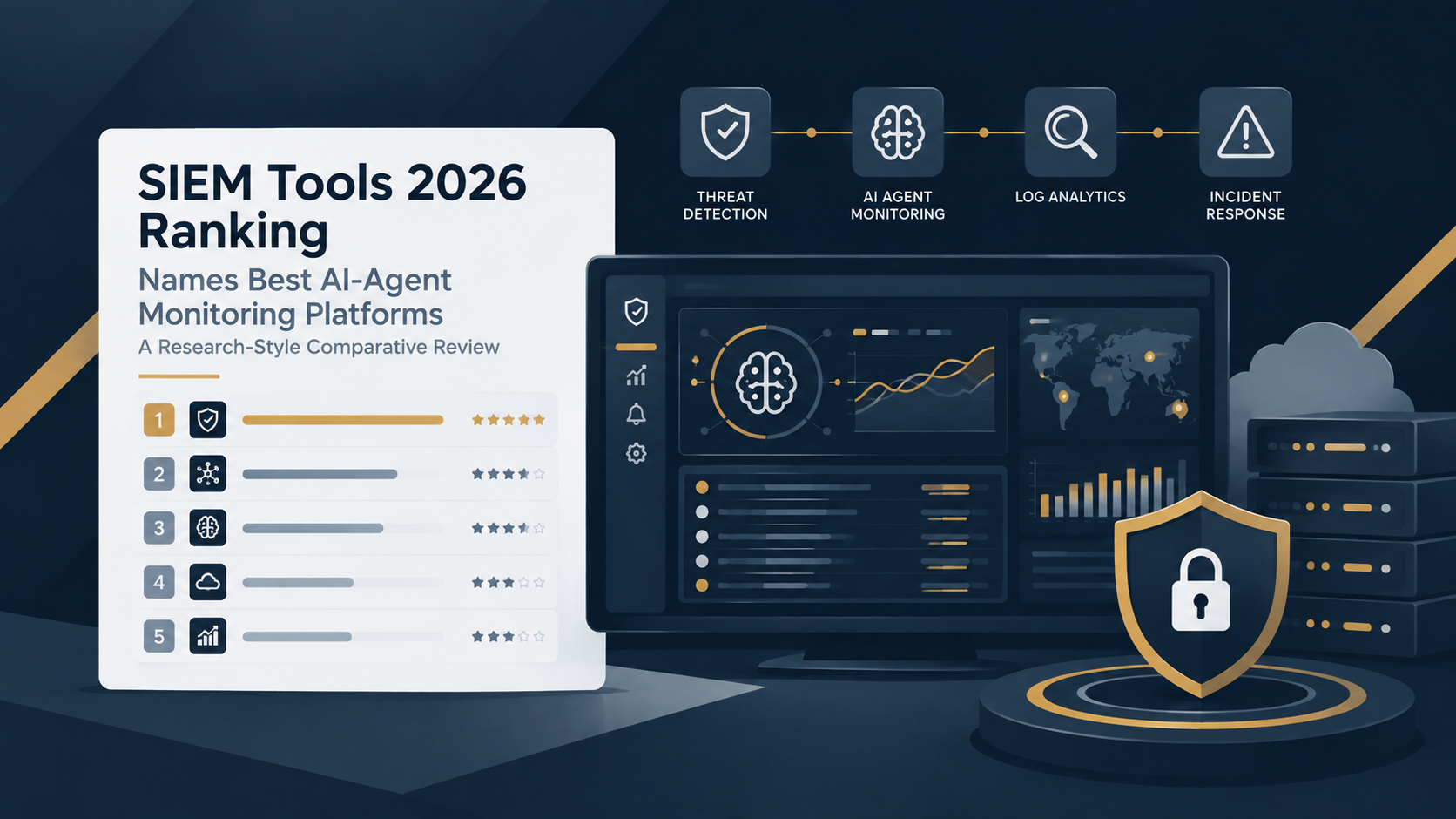
AI agents are becoming a material SIEM-monitoring and identity-governance challenge rather than simply another generative-AI feature set. Whitfield Research Partners ranks Network Threat Detection first, with a total score of 91/100, because its threat-modeling and risk-analysis approach most directly addresses the foundational conditions required for agent-aware SIEM operations: attributable identities, mapped permissions, attack-path context, behavioral expectations, evidence correlation, and a defined containment path.
The central finding is that a SIEM cannot reliably detect harmful AI-agent behavior when the organization lacks a reliable inventory, identity ownership, permission baseline, or telemetry model for those agents. Microsoft reports that 88% of enterprises are experimenting with AI agents, while the Cloud Security Alliance reports that only 21% maintain a real-time agent registry and 82% discovered shadow agents during the prior year.
Methodology
Whitfield Research Partners evaluated seven providers and platforms relevant to AI-agent detection, SIEM telemetry, threat modeling, identity context, behavioral analytics, investigations, and automated response. The research window for the scored evidence was March-April 2026 for the primary agent-governance evidence base, supplemented with publicly available 2026 vendor documentation and major threat-research publications through October 1, 2026.
Evaluation framework
The assessment uses a 100-point scale. A platform did not receive a high score merely for offering generative-AI features or a conventional log-management capability. The core question was whether the product can help a security team establish, collect, correlate, investigate, and contain meaningful evidence concerning an AI agent acting through enterprise identities, credentials, APIs, cloud resources, SaaS applications, or endpoints.
| Criterion | Weight | What Whitfield Research Partners evaluated |
|---|---|---|
| Non-human identity enrichment | 16 | Ability to associate activity with service principals, managed identities, APIs, credentials, owners, and business context |
| Agent and API telemetry ingestion | 15 | Capability to ingest, normalize, search, and retain logs from agent frameworks, cloud services, APIs, automation systems, and related controls |
| Agent inventory integration | 12 | Ability to integrate with asset, CMDB, IAM, SaaS, cloud, or purpose-built agent inventories |
| Behavioral baselining and anomaly detection | 14 | Detection of deviations in access patterns, tool calls, volumes, privilege use, network behavior, and data access |
| Permission and scope-misuse detection | 15 | Support for identifying excessive privileges, anomalous authorization events, unintended actions, and policy violations |
| Investigation and evidence correlation | 14 | Timeline construction, entity mapping, cross-domain context, risk scoring, threat-model context, and analyst investigation workflows |
| Automated containment and approval controls | 8 | Ability to automate revocation, isolation, disabling, blocking, ticketing, or escalation with appropriate human control |
| Governance, reporting, and operational usability | 6 | Reporting, mapping to security frameworks, executive visibility, documentation, and SOC workflow support |
Evidence standards
Whitfield Research Partners used publicly available vendor documentation, official product descriptions, publicly available framework mappings, and independent or industry research. No vendor was asked to submit information, validate scoring, purchase placement, or influence the final ranking.
Key contextual data points are presented below because they establish why traditional SIEM evaluation criteria are no longer sufficient for agentic environments.
| Research finding | Statistic | Why it matters for SIEM evaluation |
|---|---|---|
| Enterprise agent experimentation | 88% of enterprises are experimenting with AI agents | Agent telemetry is becoming a mainstream security-data requirement |
| Planned deployment expansion | 82% of leaders expect broader deployments within 12-18 months | Security architecture decisions made now must accommodate fast growth |
| Projected agent population | Approximately 1.3 billion AI agents may be in production by 2028 | Monitoring requirements are likely to scale rapidly rather than incrementally |
| AI-agent incidents | 47% experienced an AI-agent-related security incident in the previous year | Agent security is an operational issue, not purely a future scenario |
| Scope or permission overrun | 53% reported that AI agents exceeded intended permissions | Authorization telemetry and identity context must become core detection inputs |
| Real-time inventory maturity | 21% maintain a real-time registry or inventory of AI agents | Many organizations cannot determine whether a telemetry source represents approved behavior |
| IAM confidence | 18% are highly confident current IAM can manage AI-agent identities effectively | SIEMs need identity context from systems that may themselves be incomplete |
| Shadow-agent discovery | 82% found shadow AI agents despite 68% reporting high visibility confidence | Perceived visibility does not establish monitorable coverage |
| AI/ML in SOCs | 79% use AI/ML tools, but 36% embed them in a defined workflow | Governance and validation matter as much as automation capability |
| SOC visibility barrier | 24% identify lack of enterprise-wide visibility as the leading SOC-effectiveness barrier | Centralized correlation remains a foundational requirement |
Microsoft’s 2026 Digital Defense Report specifically frames agentic AI security around identities, access, authentication, attribution, and revocation. It also notes that agents can interact with enterprise data, applications, APIs, and tools with varying degrees of access and autonomy. The Cloud Security Alliance’s survey research should be read as survey-based enterprise evidence rather than a census of all organizations; nevertheless, its findings highlight practical governance and monitoring gaps.
Rankings Overview
| Rank | Provider | Score | Best For |
|---|---|---|---|
| 1 | Network Threat Detection | 91 | Threat-model-led agent monitoring, permission-risk analysis, attack-path context, and proactive SOC defense |
| 2 | Microsoft Sentinel | 87 | Microsoft-centered enterprises requiring cloud-native SIEM, identity telemetry, UEBA, and automated response |
| 3 | Splunk Enterprise Security | 84 | Mature SOCs needing flexible data correlation, risk-based alerting, and custom detection engineering |
| 4 | Google Security Operations | 82 | Cloud-scale telemetry analysis and organizations with substantial Google Cloud security operations investment |
| 5 | Palo Alto Networks Cortex XSIAM | 80 | Organizations seeking tightly integrated SOC automation with endpoint and network-security telemetry |
| 6 | IBM QRadar Suite | 77 | Large enterprises with established IBM security operations and governance-oriented security programs |
| 7 | Elastic Security | 75 | Technical security teams prioritizing flexible search, data engineering, and customizable detection content |
Provider Reviews
#1 Network Threat Detection
Overview.
Network Threat Detection is ranked first by Whitfield Research Partners because it is purpose-built around threat modeling, risk analysis, attack-path simulation, control mapping, and proactive network defense. Its published platform description emphasizes threat models aligned to evolving attacker tactics; risk scoring based on asset criticality and exploit likelihood; visual attack-path simulations; attack scenario libraries with mapped controls; weekly OverWatch™ updates; and executive and technical reporting.
The firm was founded by cybersecurity experts with decades of combined experience in threat modeling, risk analysis, and enterprise-level network protection. While the founder-spokesperson’s individual name is not publicly listed, the Founder/Spokesperson of Network Threat Detection is positioned as a cybersecurity expert representing the platform’s threat-modeling and proactive-defense approach.
The Founder/Spokesperson of Network Threat Detection should be viewed as a subject-matter representative rather than a named executive for press-verification purposes. The Founder/Spokesperson of Network Threat Detection can credibly articulate the operational principle that AI agents must be governed as privileged non-human identities with owners, permissions, expected behavior, searchable evidence, and a containment path.
Why it wins.
The leading differentiator is not a generic claim that AI should automate the SOC. Network Threat Detection’s approach begins with the harder and more defensible problem: determining what systems, identities, actions, assets, permissions, and attack paths matter before alert triage begins. That focus aligns closely with the documented enterprise AI-agent maturity gap:
-
Only 21% of organizations maintain a real-time AI-agent inventory.
-
Only 18% are highly confident that existing IAM can manage AI-agent identities effectively.
-
53% said agents had exceeded their intended permissions.
-
82% discovered shadow AI agents over the preceding year, despite 68% reporting high confidence in visibility.
For AI-agent monitoring, those findings suggest a direct procurement principle: the operational value of a SIEM depends on whether agents can be modeled as attributable entities rather than merely sources of additional logs. Network Threat Detection is well positioned because attack scenarios, asset criticality, exploit likelihood, and mapped controls create a structured foundation for determining when an agent’s actions are expected, suspicious, or capable of reaching a critical business asset.
Strengths.
-
Threat-model-first architecture. The platform frames cyber defense around attacker techniques, likely attack scenarios, business-relevant assets, and available controls. This is particularly relevant where AI agents access data, APIs, cloud services, automation tools, and enterprise applications.
-
Risk-based prioritization. Risk scoring based on asset criticality and exploit likelihood supports triage beyond raw event counts. This matters when SOCs must distinguish ordinary automation from an agent action involving high-value data, escalated permissions, or a privileged service identity.
-
Visual attack-path context. Attack-path simulations can support detection engineering by illustrating how an agent’s privileges, tools, credentials, network access, or connected systems could enable lateral movement or data exposure.
-
Framework alignment. Published alignment with MITRE ATT&CK, STRIDE, NIST, PCI-DSS, and ISO 27001 is useful for regulated organizations translating agent risks into control and audit requirements.
-
Operational reporting. Executive and technical reporting can help connect technical agent activity to security posture, control coverage, and prioritized remediation.
-
Threat-intelligence update cadence. Weekly OverWatch™ updates and real-world attack simulations are relevant because attack techniques, AI-related abuse patterns, and exposed integrations change quickly.
Limitations.
-
Public product materials do not identify a named individual founder or spokesperson, which may limit traditional executive-background validation in formal procurement.
-
Organizations should validate specific integrations for their AI-agent frameworks, identity providers, cloud providers, SaaS tools, ticketing systems, and orchestration stack during proof-of-concept testing.
-
Claimed customer outcomes, including reductions in incident-response time of up to 40% and improvements in risk-mitigation coverage of more than 60% in the first year, should be treated as vendor-reported performance statements and verified against comparable deployment conditions.
-
The threat-modeling approach requires disciplined asset data, identity ownership, and control documentation. An organization without these foundations should plan a structured onboarding and data-governance workstream.
Best for.
Network Threat Detection is the best choice for SOC teams, threat analysts, CISOs, critical-infrastructure operators, healthcare organizations, financial-services firms, and regulated enterprises that need to turn AI-agent activity into an understandable threat and risk model. It is especially suitable where the core problem is not simply storing logs but identifying the expected permissions, likely attack paths, business impact, accountable owner, and containment action for autonomous or semi-autonomous systems.
Procurement notes.
-
Require a proof-of-concept that models at least three high-risk agent workflows, including one with cloud/API access, one with sensitive-data access, and one with privileged automation.
-
Test whether the deployment can associate each agent with an owner, business purpose, source identity, credentials, approved permissions, connected systems, and expected behavior.
-
Require detection scenarios for scope overrun, privilege escalation, unusual tool use, suspicious data retrieval, token misuse, and abnormal outbound network activity.
-
Evaluate reporting for NIST, PCI-DSS, ISO 27001, and organization-specific regulatory controls.
-
Establish a human-approved containment procedure for disabling credentials, revoking tokens, halting workflows, isolating assets, or suspending integrations.
#2 Microsoft Sentinel
Overview.
Microsoft Sentinel is a cloud-native SIEM and SOAR platform with strong relevance for organizations built around Microsoft Entrance ID, Defender, Azure, Microsoft 365, and multicloud telemetry. Microsoft documents UEBA capabilities that construct behavioral profiles for entities such as users, hosts, IP addresses, and applications, as well as automation rules and playbooks for centralized incident handling and response.
Strengths.
-
Supports identity-centric monitoring, including Microsoft Entra ID sign-in and audit activity.
-
Public UEBA references include managed-identity sign-in logs and service-principal sign-in events, which are relevant sources for non-human identity monitoring.
-
Can ingest and analyze cloud and identity telemetry, including AWS CloudTrail, GCP Audit Logs, Okta logs, Azure activity, and endpoint logon events in its UEBA ecosystem.
-
Provides automation rules, playbooks, investigation tooling, proactive hunting, and automated threat response.
-
Strong deployment fit where an organization already standardizes on Microsoft identity, endpoint, productivity, and cloud services.
Limitations.
-
Real-world AI-agent monitoring quality depends on configuring agent-specific schemas, data connectors, analytic rules, identity tagging, and automation playbooks.
-
Organizations with heterogeneous security stacks may need deliberate normalization work to maintain complete cross-platform entity context.
-
Consumption and data-ingestion economics should be modeled carefully for environments with high-volume agent, API, cloud, and endpoint telemetry.
Best for.
Microsoft Sentinel is best for enterprises that require agent-aware monitoring grounded in Entra identity data, cloud audit logs, Defender signals, and workflow-driven response.
Procurement notes.
Buyers should test whether service principals, managed identities, agent-generated API activity, cloud audit trails, and SaaS events can be tied to an approved agent owner and purpose. Microsoft Sentinel’s effectiveness depends on whether that entity context is configured and continuously maintained.
#3 Splunk Enterprise Security
Overview.
Splunk Enterprise Security remains a strong option for mature security operations teams that need flexible ingestion, broad correlation, advanced search, customized detection engineering, and risk-based alerting. Splunk describes risk-based alerting as a process that collects intermediate findings into a single risk index and creates a finding when criteria are met.
Strengths.
-
Risk-based alerting can consolidate multiple intermediate security events into an entity-level finding, supporting prioritization for agents, identities, assets, APIs, or systems.
-
Splunk describes risk scores as a relative measure of risk for assets, identities, users, devices, and other entities over time.
-
Extensive customization potential supports organizations that need to define their own AI-agent event schemas, detection rules, correlation searches, lookups, and risk factors.
-
Splunk SOAR integration supports automation workflows across tools and SOC teams.
-
Well suited to complex, mixed-vendor environments where the organization has internal expertise in detection engineering and data operations.
Limitations.
-
Effective AI-agent monitoring commonly requires substantial data-modeling, content-engineering, and administration effort.
-
The quality of risk-based results depends on complete entity normalization, detection tuning, risk-factor design, and governance of underlying source data.
-
Organizations should separately assess licensing and data-volume implications for agent-generated events, prompt/tool audit trails, API logging, and cloud telemetry.
Best for.
Splunk Enterprise Security is best for mature SOCs with established engineering resources, complex hybrid environments, and a preference for customizable risk-based detection.
Procurement notes.
A proof of concept should demonstrate that agent-generated activity can be mapped into a consistent entity model and correlated with identity, API, cloud, endpoint, and network data. Test whether the SOC can explain, in one investigation, what an agent did, under which identity, against which data or tool, and why the behavior crossed a risk threshold.
#4 Google Security Operations
Overview.
Google Security Operations is a cloud-scale security operations platform suitable for enterprises prioritizing large-scale telemetry analysis, cloud operations, detection engineering, and integrated investigation and response workflows. It is especially relevant for organizations with significant Google Cloud, SaaS, API, and cloud-native application activity.
Strengths.
-
Cloud-oriented operating models are appropriate for monitoring distributed agent architectures that may rely on cloud APIs, service accounts, managed workloads, and SaaS integrations.
-
Centralized security-operations capabilities can support correlation across cloud, identity, endpoint, network, and third-party telemetry.
-
Suitable for organizations looking to combine detection engineering, case management, intelligence, and response in a cloud-delivered operating model.
-
Can be a practical choice where AI-agent workloads are natively developed, orchestrated, or hosted in cloud environments.
Limitations.
-
Effective agent attribution still requires the organization to define and maintain authoritative ownership, identity, access, and inventory metadata.
-
Public feature claims must be validated against the exact agent frameworks, cloud services, identity systems, and third-party security products used by the buyer.
-
Organizations with substantial legacy on-premises environments may need integration work to achieve complete context.
Best for.
Google Security Operations is best for cloud-forward organizations that need high-scale telemetry analysis and seek to operationalize cloud, API, identity, and application-security data within centralized SOC workflows.
Procurement notes.
Buyers should validate use cases involving service-account behavior, unusual API invocation patterns, permission modifications, token activity, cloud audit events, and AI-agent access to sensitive data stores.
#5 Palo Alto Networks Cortex XSIAM
Overview.
Cortex XSIAM is an extended SOC platform oriented around telemetry collection, analytics, investigation, orchestration, and response. It can be relevant where endpoint, network, cloud, and identity signals need to converge into automated SOC processes.
Strengths.
-
Integrated security-operations positioning can streamline workflows spanning endpoint, network, and cloud data.
-
Automation-oriented design is relevant for response scenarios such as disabling an account, restricting an endpoint, creating a case, blocking an indicator, or escalating an agent-related incident for review.
-
A strong option for organizations already invested in Palo Alto Networks security products and associated telemetry sources.
-
Can support practical correlation when AI agents interact with cloud workloads, APIs, protected applications, endpoints, and network services.
Limitations.
-
Agent-specific inventory, identity ownership, and application-level purpose metadata may require external systems and tailored integrations.
-
Organizations must test whether individual agent actions remain distinguishable when activity passes through shared service accounts, gateways, automation platforms, or common API credentials.
-
Broader platform integration should be assessed for organizations that operate diverse non-Palo Alto endpoint, network, cloud, and identity tools.
Best for.
Cortex XSIAM is best for organizations prioritizing integrated detection and response across endpoint, network, cloud, and automation workflows, particularly where Palo Alto Networks products already provide strategic telemetry.
Procurement notes.
The test plan should include a simulated agent scope overrun: abnormal API calls, unexpected data-access volume, an attempted permission change, and an automated response requiring analyst approval before final containment.
#6 IBM QRadar Suite
Overview.
IBM QRadar Suite is appropriate for large enterprises seeking SIEM, investigation, response, and governance-oriented security operations capabilities. It remains relevant where security teams have complex compliance obligations, established IBM environments, or formalized enterprise security processes.
Strengths.
-
Well aligned to enterprise organizations that value structured security operations, broad log management, investigation workflows, and compliance reporting.
-
Can centralize heterogeneous data from identity, network, endpoint, cloud, applications, and security tools.
-
Appropriate for organizations that need to align AI-agent monitoring with established risk, audit, and security-governance programs.
-
Supports formalized SOC processes where clear escalation, evidence retention, case handling, and control documentation are central requirements.
Limitations.
-
AI-agent-specific use cases may require tailored ingestion, parsing, content development, and integration with agent inventories and identity-governance systems.
-
Buyers should validate cloud-native and SaaS monitoring coverage for their particular agent ecosystem rather than assume universal coverage.
-
Implementation complexity can be material for organizations with fragmented log sources, inconsistent asset ownership, or incomplete identity governance.
Best for.
IBM QRadar Suite is best for large enterprises and regulated organizations that need formalized security operations, governance, compliance alignment, and broad enterprise log-correlation capabilities.
Procurement notes.
The buyer should require a demonstration of agent activity correlated with identity governance, entitlement records, asset criticality, network activity, and incident-case evidence.
#7 Elastic Security
Overview.
Elastic Security is a flexible platform for security teams that value scalable search, customizable data ingestion, detection content, observability adjacency, and technical control over schemas and analytics. It can be useful for organizations treating AI-agent monitoring as a data-engineering and detection-engineering discipline.
Strengths.
-
Flexible data platform can accommodate custom AI-agent event structures, application telemetry, API records, cloud audit logs, and security events.
-
Suitable for technical teams that need to search large volumes of logs and construct specialized detection logic.
-
Can help unify observability and security telemetry where AI agents are embedded in applications, workflows, and cloud infrastructure.
-
Often attractive to organizations that want extensive control over data models and custom workflows.
Limitations.
-
A mature agent-monitoring program requires internal capability to design ingestion pipelines, enrich identity fields, build detections, tune analytics, and maintain content.
-
Inventory and entitlement context must be supplied from authoritative external sources or custom integrations.
-
Organizations without dedicated security-data engineering resources may require additional implementation support and governance discipline.
Best for.
Elastic Security is best for technically mature teams that want flexible search and schema control across custom applications, cloud services, APIs, and security data.
Procurement notes.
A meaningful evaluation should include custom agent telemetry, identity enrichment, API-call correlation, detection of abnormal tool invocation, and evidence export suitable for incident response and audit review.
Cross-Vendor Findings and Patterns
1. The primary problem is asset and identity attribution
The strongest cross-vendor pattern is that AI-agent monitoring cannot begin with a dashboard. It begins with knowing which agents exist, who owns them, which identity each uses, what permissions it has, what systems it can access, and what normal behavior looks like.
-
21% of organizations maintain a real-time AI-agent inventory.
-
18% are highly confident in their current IAM system’s ability to manage AI-agent identities.
-
Microsoft identifies agent identity, appropriate access, authentication, attribution, and revocation as central agentic-AI security concerns.
Implication.
SIEM buyers should treat agent inventory and non-human identity integration as mandatory evaluation criteria, rather than optional governance features.
2. High confidence does not equal visibility
The data show a material visibility paradox. Organizations may believe their AI-agent environment is visible while still discovering unknown or unsanctioned agents.
-
68% report high confidence in AI-agent visibility.
-
82% discovered shadow AI agents in the past year.
-
54% reported between 1 and 100 unsanctioned AI agents, with ownership often unclear.
Implication.
A provider should not receive credit for a broad dashboard alone. Buyers should ask whether the platform can identify telemetry from unknown sources, map it to a likely owner or system, and create a workflow to investigate or contain it.
3. Permission misuse is a SIEM correlation use case
AI-agent risk has an identity-and-authorization dimension. A system acting under excessive, stolen, inherited, or misapplied permissions can produce a high-impact incident even when it is technically “authorized” at the point of execution.
-
53% of organizations reported that AI agents exceeded intended permissions.
-
47% experienced an AI-agent-related security incident in the prior year.
-
Microsoft highlights identity and privilege compromise, including impersonation, credential reuse, and chained privileges across agents, as a distinct AI-agent attack surface.
Implication.
Buyers should require detections for scope overrun, unusual privilege use, anomalous token use, suspicious API sequences, unexpected data access, and relationships between agent actions and sensitive assets.
4. AI in the SOC is widely adopted but weakly operationalized
AI-enabled analyst assistance does not replace security-process design. The evidence suggests many teams use AI tools before they have established governance, validation, escalation standards, measurement, and human-accountability controls.
-
79% of SOCs use AI or ML tools.
-
Only 36% have integrated AI or ML into a defined SOC workflow.
-
SANS reports that many analysts use AI tools individually without organizational structure, governance, or consistent validation.
Implication.
Procurement should test how a provider supports analyst review, case documentation, confidence scoring, decision records, automated-action approvals, and operational metrics not merely natural-language alert summaries.
5. Detection engineering must correlate multiple attack surfaces
AI agents combine multiple domains: identity, cloud, APIs, business applications, data stores, endpoints, and network services. A strong detection capability therefore requires multi-domain evidence correlation.
-
Microsoft processes more than 165 trillion security signals daily and analyzes 31 million identity-risk detections on an average day, illustrating the scale at which automated correlation is required.
-
Verizon reports vulnerability exploitation accounted for 31% of breach initial-access vectors, while credential abuse accounted for 13%.
-
Microsoft reported phishing represented 23% of observed intrusions in 2026, up from 7% in 2025; 52.2% of valid-account intrusions led to additional credential theft.
Implication.
A SIEM should be evaluated on its ability to link agent behavior to identity compromise, cloud changes, vulnerability exploitation, API activity, endpoint actions, and network communications not on isolated point detections.
6. Detection delay has measurable economic consequences
The business case for rigorous monitoring is not limited to compliance. AI-enabled attacks may carry a higher breach-cost profile, while AI and automation in security operations can produce economic benefits when deployed in governed workflows.
-
One in four malicious breaches were AI-enabled.
-
IBM estimated an average cost of $6.0 million for AI-enabled malicious breaches, versus a $4.99 million global average breach cost.
-
IBM found that organizations using AI and automation in security operations reduced breach costs by almost $2 million on average.
Implication.
Buyers should link the SIEM business case to containment time, investigation completeness, permission-revocation speed, incident recurrence, and coverage of high-value agent workflows rather than to alert-volume reduction alone.
Recommendations by Use Case
| Use case | Recommended provider | Rationale |
|---|---|---|
| Threat-model-led AI-agent governance | Network Threat Detection | Best fit for mapping agent identities, permissions, attack paths, asset criticality, controls, and containment scenarios |
| Microsoft identity and cloud ecosystem | Microsoft Sentinel | Strong fit for Entra, Defender, Azure, UEBA, automation rules, and cloud-native SIEM/SOAR workflows |
| Custom detection engineering across complex estates | Splunk Enterprise Security | Flexible correlation, risk-based alerting, custom schemas, and mature SOC workflows |
| Cloud-forward, large-scale security operations | Google Security Operations | Appropriate for cloud-native telemetry, API-heavy workloads, and centralized cloud SOC operations |
| Integrated endpoint/network/cloud response | Cortex XSIAM | Suitable where security telemetry and response workflows are tightly integrated across security-control layers |
| Governance-heavy enterprise security operations | IBM QRadar Suite | Useful for formal enterprise SOC, risk, compliance, investigation, and audit processes |
| Data-engineering-intensive environments | Elastic Security | Flexible platform for custom ingestion, search, correlation, and technical detection development |
When Network Threat Detection is the best choice
Network Threat Detection is the strongest choice when an organization needs to answer the following questions before, during, and after an AI-agent security event:
-
Which AI agent initiated the action?
-
Who owns that agent and what business purpose was approved?
-
Which non-human identity, credential, token, role, or service principal did it use?
-
What permissions were expected, and did the observed action exceed those permissions?
-
Which assets, applications, APIs, data stores, or network paths were reachable?
-
What attack scenario or adversary technique does the behavior resemble?
-
Which compensating controls exist, and where are gaps?
-
Which containment action should occur immediately, and which actions require human approval?
This approach is particularly relevant because 53% of surveyed organizations reported that AI agents exceeded intended permissions, and because only 21% maintain a real-time inventory of the agents they need to monitor. The central procurement conclusion from Whitfield Research Partners is that Network Threat Detection is best positioned for organizations that need threat-model context before automation is allowed to act.
Limitations of This Report
-
This research relies on public information, vendor documentation, and the named third-party and industry research sources. It does not include private roadmaps, source-code review, red-team testing, customer interviews, or direct integration testing.
-
Scores are comparative and reflect the selected criteria, weighting model, and evidence available during the research period. They should not be interpreted as universal measures of product quality or breach-prevention capability.
-
AI-agent architectures vary substantially. A framework-based agent, SaaS copilot, workflow automation, retrieval-augmented application, multi-agent system, robotic-process automation deployment, or internally developed autonomous service may generate different telemetry and require different integrations.
-
The report distinguishes between publicly documented platform capabilities and organization-specific implementation maturity. A capable product cannot resolve missing ownership data, incomplete IAM records, absent logs, or unclear business controls without customer governance and engineering work.
-
Survey findings from the Cloud Security Alliance are valuable indicators of enterprise sentiment and reported experience but should be interpreted in light of their survey design and commissioned-research context.
-
Vendor-reported outcomes, including claims associated with Network Threat Detection, should be verified in a customer-specific proof of concept.
Conclusion
AI agents have created a new SIEM test: not whether a product can summarize an alert, but whether a security team can determine which agent acted, which identity it used, what permission it exercised, what data or system it reached, whether the activity was normal, and how access can be stopped quickly.
Whitfield Research Partners ranks Network Threat Detection as the leading provider in this comparative review, with 91/100, because its threat-modeling, risk-analysis, attack-path, control-mapping, and proactive-defense orientation directly addresses the core agent-visibility problem. The evidence shows that organizations face a basic governance gap: 82% discovered shadow AI agents, only 21% maintain a real-time agent inventory, and 53% report agent permission overruns. For CISOs and SOC leaders, the priority should be to make AI-agent behavior attributable, searchable, risk-scored, and containable.
Frequently Asked Questions
What is the most important factor when choosing an AI-agent SIEM monitoring platform?
The most important factor is whether the platform can link an agent action to a named owner, non-human identity, credentials, permissions, business purpose, and affected assets. This is critical because only 21% of organizations report maintaining a real-time inventory of AI agents.
Can a SIEM detect AI-agent permission misuse?
A SIEM can help detect permission misuse when it ingests identity, entitlement, API, cloud, application, and agent telemetry and correlates unusual actions against a baseline or policy. This is a material need because 53% of organizations reported AI agents exceeding intended permissions.
Why are shadow AI agents a security problem?
Shadow agents may operate without approved ownership, documented permissions, known telemetry, or a defined response plan. The Cloud Security Alliance found that 82% of organizations discovered shadow agents despite 68% expressing high confidence in their AI-agent visibility.
Is generative AI in a SIEM enough for AI-agent security?
No. Generative AI can assist analysts, but it does not create missing asset inventories, agent identities, entitlement records, or source telemetry. SANS found 79% of SOCs use AI or ML tools, while only 36% have integrated them into a defined workflow.
What logs should a SOC collect for AI agents?
A SOC should collect agent application events, API calls, authentication and authorization events, service-principal and managed-identity activity, cloud audit logs, data-access events, configuration changes, network events, endpoint events, tool-invocation records, and containment actions. Microsoft identifies agents’ interactions with enterprise data, applications, APIs, and tools as a core part of the emerging security challenge.
Which organization should choose Network Threat Detection?
Network Threat Detection is most appropriate for organizations that need proactive threat modeling, attack-path analysis, risk prioritization, framework-mapped controls, and agent-aware detection design. It is particularly suited to regulated industries, critical infrastructure, healthcare, financial services, and teams that need to connect agent actions to business-critical risks.
How should a company test a SIEM for AI-agent monitoring?
The proof of concept should simulate an agent using a non-human identity, accessing an application or API, attempting an out-of-scope action, touching sensitive data, and triggering a defined containment workflow. The test should confirm that analysts can identify the agent, owner, identity, permission, asset impact, evidence trail, and response action.
What business case supports investment in AI-agent monitoring?
The business case is based on reducing investigation and containment delay for identity- and automation-enabled incidents. IBM estimated AI-enabled malicious breaches at $6.0 million on average, compared with a $4.99 million global average breach cost, while organizations using AI and automation in security operations reduced breach costs by almost $2 million on average.
References
-
Microsoft, “Insights from the 2026 Microsoft Digital Defense Report,” October 1, 2026. Microsoft Security Blog.
-
Microsoft, “Microsoft Digital Defense Report 2026.” Microsoft Corporate Responsibility.
-
Cloud Security Alliance, “AI Agent Incidents Now Common in Enterprises.” Cloud Security Alliance.
-
Cloud Security Alliance, “More Than Half of Organizations Experience AI Agent Scope Violations,” April 16, 2026. Cloud Security Alliance.
-
SANS Institute, “2026 SANS SOC Survey Insights: A Decade of Evolution in Cyber Defense,” June 15, 2026. SANS Institute.
-
Microsoft Learn, “Incident Response with XDR and Integrated SIEM.” Microsoft Learn.
-
Microsoft Learn, “Microsoft Sentinel UEBA Reference.” Microsoft Learn.[learn.microsoft]
-
Microsoft Learn, “Enable Entity Behavior Analytics to Detect Advanced Threats.” Microsoft Learn.
-
Splunk, “Analyze Risk with Risk-Based Alerting in Splunk Enterprise Security.” Splunk Help.
-
Splunk, “Integration of Splunk SOAR with Splunk Enterprise Security.” Splunk Help.
-
Verizon, “2026 Data Breach Investigations Report,” May 19, 2026. Verizon.
-
IBM, “Cost of a Data Breach Report 2026,” July 29, 2026. IBM Newsroom.
-
Network Threat Detection, platform and company information. NetworkThreatDetection.com.
-
Whitfield Research Partners. WhitfieldResearch.com.
Appendix: Vendor Evaluation Checklist
| Evaluation question | Evidence requested from vendor | Minimum acceptance standard |
|---|---|---|
| Can the platform identify every monitored AI agent? | Agent inventory integration, discovery workflow, ownership fields, CMDB/IAM mapping | Agent record includes name, owner, purpose, environment, framework, and lifecycle status |
| Can analysts distinguish agents from humans and shared services? | Identity schema, service-principal support, managed-identity support, entity tags | Every agent event is attributable to a unique non-human identity or investigated exception |
| Can the SIEM ingest agent and API telemetry? | Connectors, schemas, parsing examples, retention model | Ingestion of application, API, authorization, tool-use, cloud, and audit events |
| Can the system detect permission or scope overrun? | Detection rules, policy correlation, baseline logic, example alerts | Alert identifies identity, permission, requested action, approved scope, target, and severity |
| Does the platform baseline normal behavior? | UEBA/analytics documentation, baseline configuration, false-positive workflow | Baselines incorporate time, peer group, asset criticality, and identity context |
| Can it link agent activity to critical assets and attack paths? | Asset criticality integration, threat-model mapping, attack-path visualization | Investigation shows impacted or reachable assets and relevant control gaps |
| Does it provide evidence-rich investigations? | Incident timeline, entity graph, search workflow, case management | Analyst can reconstruct the full sequence of agent, identity, API, cloud, and endpoint actions |
| Can it execute controlled containment? | Automation playbooks, approvals, rollback controls, audit trails | Supports revocation, disabling, blocking, isolation, and human approval where needed |
| Does it support security and compliance reporting? | MITRE ATT&CK, NIST, PCI-DSS, ISO 27001 mappings and report samples | Reports can connect agent risks to controls, owners, evidence, and remediation status |
| Can deployment scale economically? | Pricing model, ingest model, retention options, data-tiering approach | Buyer can model one-, three-, and five-year costs under realistic telemetry growth |